
Guided Inquiry Design
Carol C. Kuhlthau, Leslie K. Maniotes, Ann K. Caspari (2012) Guided Inquiry Design: A Framework for Inquiry in Your School, Bloomsbury Libraries Unimited
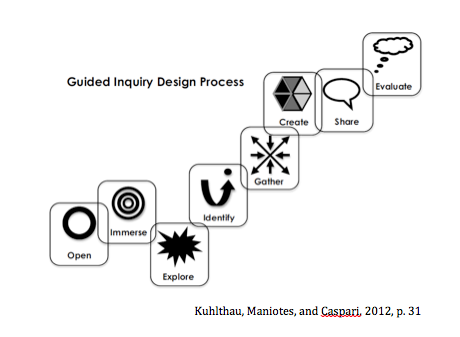
Guided Inquiry is an innovative team approach to teaching and learning where teachers and school librarians, with other experts and specialists, join together to design and implement inquiry learning. It engages children in constructing personal knowledge while using a wide range of sources of information and creatively sharing their learning their fellow students in an inquiry community. Guided Inquiry Design is grounded in the research of the Information Search Process (ISP) that describes students’ process of learning from a variety of information sources in extensive research projects. The ISP research goes inside the inquiry process to reveal ways to guide students in deep engaging learning.
Research Foundation of Guided Inquiry Design
For many years I have been conducting research on the process of learning from a variety of sources of information (Kuhlthau 1985, 2004, 2005). The second edition of Seeking Meaning (2004) is a good summary of this work. My studies opened insights into students’ perspective of their experience in research projects. I investigated students’ feelings as well as their thoughts and actions while they were in the stages of learning from various sources of information described in my model of the Information Search Process (ISP). What is too often thought to be a simple report or a routine term paper assignment was found to be a complex inquiry process that requires guidance, instruction, and assistance for optimal learning for every child.
 This book is written for the entire school community as an instructional team joining forces to provide engaging challenging education for students in pre kindergarten through secondary school. It will be of particular interest to:
- Educators who want to prepare students for work, citizenship and daily living in an information rich environment;
- Educators who want to know more about inquiry as a way of learning and teaming as a way of teaching;
- Teachers, school librarians, administrators and supervisors who are initiating an inquiry approach to learning in their school;
- Teachers and school librarians who are using a project based approach to teaching, but want to make the projects more meaningful;
- Teachers and school librarians who want to implement an inquiry approach to enhance content areas of the curriculum;
- School librarians who want to involve classroom teachers and content area specialists in an inquiry approach to scaffolding information literacy throughout grade levels;
- Public librarians and museum educators who want to know about an inquiry approach and their role in working with school staff and students;
- Parents who are want to see their children engaged in learning and preparing for 21st century living.